The majority of students are eager to dedicate themselves to their studies. They are ready to make sacrifices. They want to work hard for their dreams. Yet they lack one thing. They don’t know WHERE to start.
After graduation, students often find themselves at the crossroads of an important phase in their lives. Some sit thinking about jobs. Some start thinking about pursuing higher studies. Some students start looking for HOW to start preparing for competitive exams like UPSC.
If you are at that stage, don’t worry about how tough preparing for UPSC is. Think about how you should START preparing for UPSC the right way.
The Union Public Service Commission Civil Services Examination is one of the most respected examinations in India. Along with testing your memory, it tests your analytical ability, patience, discipline, awareness, and decision-making skills too. Students who prepare for UPSC must be able to understand society, governance, the economy, politics, current events, and ethical issues, as well as the changing world around them. Such an extensive journey cannot be completed by simply reading books, but by following a properly structured method of learning.
Starting UPSC preparation during one's graduation years is frequently seen as optimal. By this age, students have acquired a basic level of academic maturity. You can understand concepts in depth, find connections between different subjects, read newspapers seriously, and think about national issues from a broad perspective. What students often lack at this stage is a clear understanding of how to begin. Starting UPSC preparation without knowing the exam pattern, syllabus, and important previous year question papers, or understanding your personal strengths, can feel overwhelming.
Don't let panic or the competitive aspect dictate how you start preparing for the UPSC Civil Services exams after graduating. It should BEGIN with UNDERSTANDING. Every serious student must know EXACTLY what they are getting into. They should know WHAT to study, HOW much time they have, and WHAT kind of schedule they can follow for a long period of time.
If you have just graduated and are looking for a STEP-BY-STEP guide to start UPSC preparations the SMART way, you are at the right place. Here is a step-by-step guide to starting your UPSC preparation journey in a disciplined and effective way. It will help you know the correct path, prevent you from making common mistakes and guide you to prepare WITHOUT pressure, but WITH purpose, planning, and persistence.
Graduation is one of the most important stages in a student’s life. Following this stage, students start to truly engage with the world beyond just what's found in books and classrooms. Up until college, it's mostly your teachers, parents, and exams driving your studies and how you learn. After graduation, you start giving more thought to your career goals, responsibilities, and social obligations.
It’s for this very reason that beginning your UPSC journey after graduation makes a lot of sense. By this stage, a student has already developed basic academic knowledge and a certain level of maturity. Their minds are more capable of understanding subjects like polity, economy, history, environment, society, and international relations.
Furthermore, beginning your UPSC journey post-graduation allows for a more focused and serious approach to planning. At this point, students are mature enough to grasp that UPSC requires more than just cramming at the last minute. This journey demands daily reading, consistent revision, honing your answer-writing skills, keeping up with current events, and emotional resilience. Students who start after graduation understand this need more clearly and can prepare with more responsibility.
Graduation offers a chance to really see where your talents lie and where you still need to grow. Perhaps you have a solid grasp of those humanities-related general studies topics. Or you might be from a science, commerce, engineering, or medical background. This background can help you choose the right optional subject and build a preparation strategy that suits your own ability. Instead of following someone else's road map, you can prepare according to your interest level, time, and learning capacity.
At the same time, this stage also gives students the opportunity to develop important habits. Reading the newspaper, taking notes, analyzing government policies, discussing social issues with friends, and practicing answer writing are vital habits. These habits cannot be developed in one day; they require time and a certain level of discipline.
Therefore, starting UPSC preparation after graduation is not only about having more time to study. It is about having the right age, maturity, and awareness to understand the purpose of the examination. A student who starts with clarity after graduation can slowly build the foundation required for this long journey.
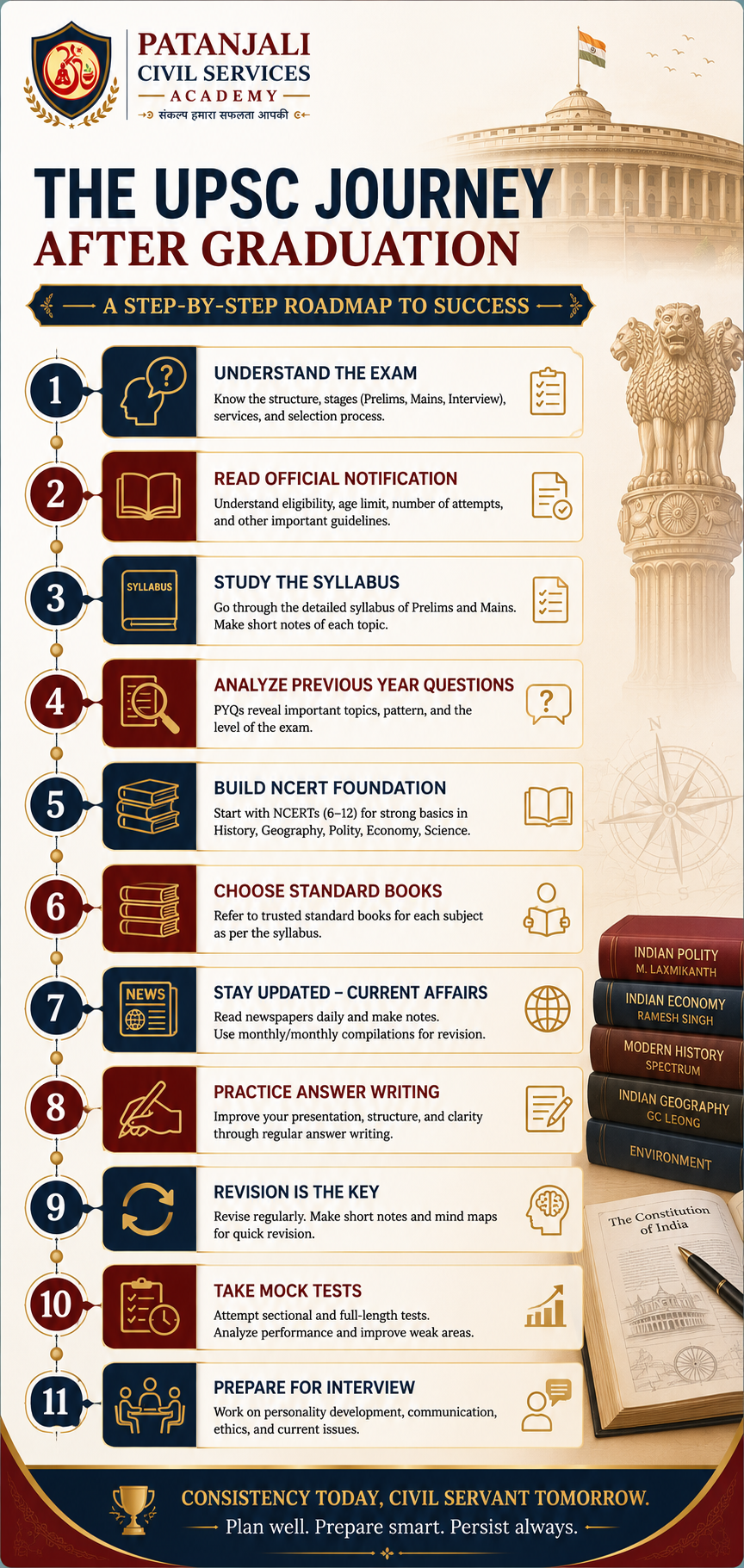
Before you start preparing for UPSC, step 1 is to get an idea of what this exam really requires from you. Many aspirants jump into gathering books, watching lectures and making timetables right away. It's no surprise then that they get flustered early on, given that UPSC isn't just about one subject. It’s an exam which assesses you on your knowledge, awareness, reasoning, writing skills, personality and decision making skills.
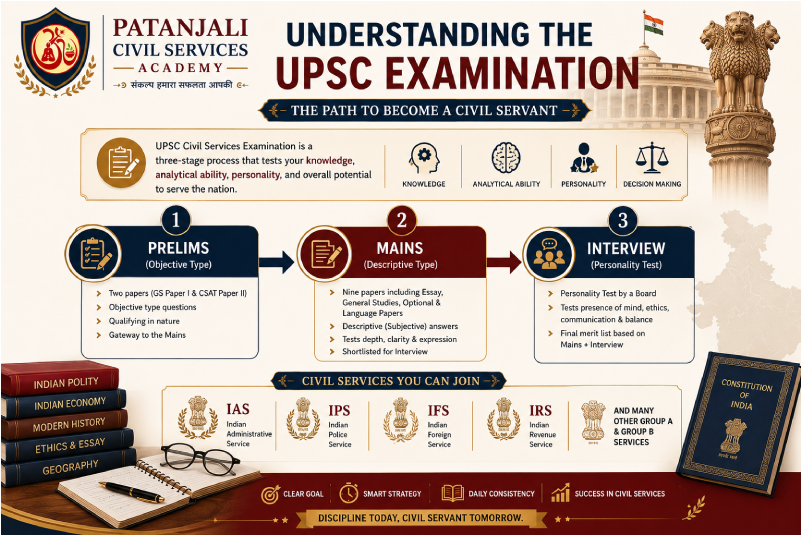
Civil Services Examination conducted by UPSC aims at selecting the suitable candidates for some of the most prestigious public services of the country. Students tend to relate UPSC to only IAS. However, this exam grants you eligibility for other services too like IPS, IFS, IRS and many other central services. So instead of thinking about this exam as a test for only one post, it should be approached as a step towards your aim of being in the field of public administration and serving the nation.
The examination consists of three major stages. The first stage is the Preliminary Examination, which is of an objective type. This stage is primarily meant for screening candidates for the Mains. The Mains comprise descriptive written papers where the candidate must express their thoughts in writing. This stage tests your knowledge as well as your ability to express yourself clearly and logically. The final stage is the Personality Test, or interview, where the candidate's personality is examined.
Evidently, the exam assesses you across multiple competencies. Therefore, while preparing for UPSC, reading up facts and figures alone won’t help you. If you can’t utilise those facts in your answers, relate them to current issues or present your opinion about them in a balanced manner, your preparation will be incomplete. Along with knowledge, UPSC also tests your understanding of a situation. So, be ready to analyse topics from multiple perspectives. For instance, a topic like environment is not only about forests or animals. It overlaps with economy, agriculture, health, climate change, international agreements, government policies etc. Governance is not just about administration. It overlaps with ethics, law, society, welfare schemes and citizen participation. This is why a holistic approach is required for UPSC preparation.
Therefore, for any graduate embarking on UPSC preparation, an initial step should be to thoroughly review the exam pattern, syllabus, and past papers. Once candidates are aware of these aspects, they will have an idea of the type of knowledge needed for the exam and how this knowledge is expected to be applied. Without this basic understanding, the entire preparation may suffer from being disjointed. Preparing for UPSC without knowing the exam is like starting a journey without knowing the road.
If you know where you are going and which road leads you there, you will be more organised in your journey. Similarly before you open your first book as a UPSC aspirant, know the examination thoroughly. This knowledge will be the basis of your preparation.
Before starting UPSC preparation, every graduate should first read the official UPSC notification carefully. While many students jumpstart their preparation by buying books or joining coaching institutes right away, the notification is the very first piece of paper which lays down the ground rules of the examination.
It outlines essential details like academic prerequisites, age restrictions, the permitted number of attempts, and reservation guidelines, alongside the application procedure, exam phases, and syllabus. For crucial dates, if you are genuinely committed to the UPSC exams, avoid relying solely on social media platforms or coaching advertisements. The official notification should always be treated as the most reliable source.
Students should also check their age limit and number of attempts before making a long preparation plan. Age limit and attempts may vary with the category and other eligibility criteria. Understanding these things clearly at the outset will help you stay away from future confusions. This might sound like a trivial step but important for official clarification. Candidates who begin their UPSC preparation journey with facts rather than assumptions set themselves up for success
Once done with the syllabus, work your way through previous year question papers. PYQs will help you more than random studying because it is the actual questions asked by UPSC and the way they are framed.
PYQs allow aspirants to recognise patterns of repeated themes/topics, important areas to focus on and the depth needed to answer each topic. For prelims, PYQs help with improving your knowledge on facts, concepts and developing an elimination-based approach. For mains, it helps you with understanding the demand of a question and developing your answer writing. Previous year papers aren’t just for practice; they help you understand the thinking pattern of UPSC.
With a firm grasp of the syllabus and past papers, graduates can then devise a sensible study timetable. Some students will require a 12-month preparation plan, whereas some may require 18 months or even 24 months depending on their background, hours of study, and level of preparation required.
If you are a beginner you will need more time to build your basics. If you are a repeater you may need more time focusing on revision and taking tests. If you are working you will require a longer time plan as you will have restricted hours to study.
Most unrealistic timetables fail because they don’t account for rest, revision and regular practice tests. Instead of setting daily targets try to set weekly/monthly goals. Also set targets according to the next Prelims cycle.
Just because your timetable is realistic doesn’t mean you will be preparing at a slow pace. It just means you will be prepared properly.
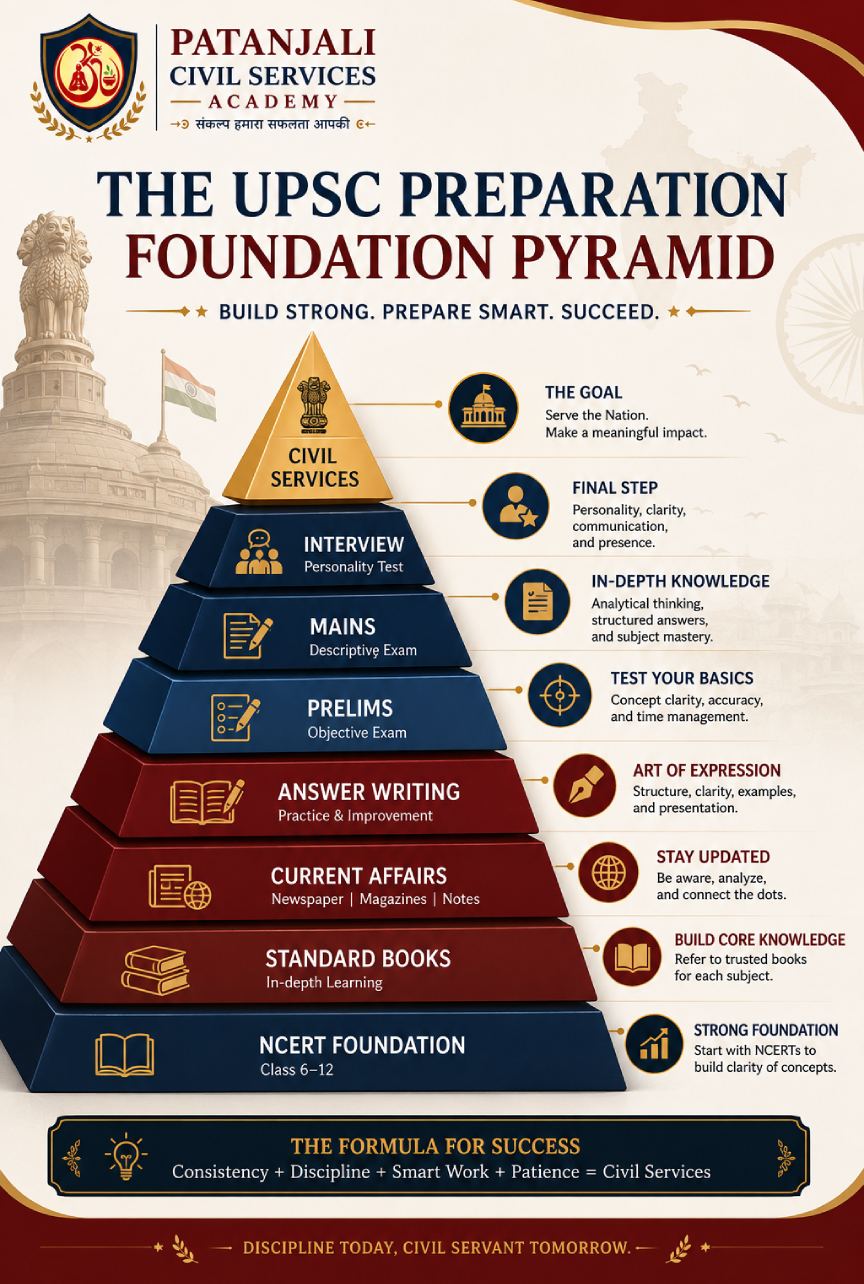
Having reviewed the syllabus and solved past papers, the next logical step is to discuss preparation strategies. Don’t start reading random heavy books if you are a beginner. A weak base will create more confusion if you opt for difficult books.
NCERT books use clear language and provide precise explanations of topics, enabling students to build a strong foundation in History, Geography, Polity, Economy, and Science—the pillars of UPSC preparation.
Your initial approach should involve NCERTs, read through several phases like so:
Another mistake a beginner might make is gathering many books—don’t do that. Quantity doesn’t matter in UPSC; it's how much you can understand and revise from limited sources.
Once basic clarity is achieved the aspirant should start referring to standard books. Books help one in building an in-depth knowledge of various UPSC important topics like Indian Polity, Modern Indian History, Ancient & Medieval Indian History, Geography, Economy, Environment, Science and Technology, Ethics, Essay and Current Affairs.
Each topic needs to be covered through limited yet trustworthy sources. One good book is better than reading 5 incomplete books on the same topic. Many aspirants tend to go on browsing for new material but they actually realise that revision is more crucial than reading. The right approach is to read fewer sources properly and revise them again and again. When a student reads the same source multiple times, concepts become clearer and preparation becomes stronger.
Prelims and Mains are part of the same examination, but they test different skills. The Prelims ask you to be precise, quick, and able to eliminate incorrect options. This stage includes questions on both static and current knowledge.
Mains is descriptive and analytical. How well you can articulate your thoughts matters in mains. A good answer is one that has an intro, main body and conclusion. It has examples, facts, arguments and is well balanced.
Hence, you cannot prepare for both stages similarly. Where Prelims needs MCQ practice, revision, and preciseness, Mains needs you to practice answer writing, understand the importance of structure, and analyze effectively.
Is coaching required for UPSC Preparation? It is a frequently asked question by UPSC aspirants. Coaching can help, but it is not compulsory. Coaching can be beneficial but is not essential. There are equal numbers of students who have prepared for the exam by self-study as those who have had proper guidance through coaching.
Coaching can provide structure to the preparation. It helps students understand the syllabus, exam pattern, important topics and answer writing approach. Guidance from experienced teachers can also save time because beginners often do not know what to read, what to avoid and how to prepare in the right direction.
But coaching is not a magic bullet. Signing up for a coaching institute will not make your preparation better by itself. The student will have to put in the effort. Studying, revising, practicing, reading current affairs and writing answers are things that an aspirant has to do on their own.
A disciplined student who utilizes their resources effectively can perform just as well through self-study. There is a wealth of materials available today, including standard textbooks, video lectures, previous year question papers, and official government resources. However, studying independently requires a great deal of consistency and self-discipline. Hence coaching can prove to be helpful only if you’re disciplined enough to make the best use of it. It can lead you on the path but can’t do the hard work for you . Consistency, clarity and hard work matter more in UPSC than coaching.
Starting UPSC preparation after graduation is an important decision. It is not only about choosing a career, but also about preparing oneself for responsibility, public service and continuous learning. A graduate who begins this journey with clarity can build the right foundation step by step.
For beginners, understanding the exam, going through the syllabus, analyzing previous years' papers, and making a realistic plan are some of the first steps towards initiating your journey. Books, coaching, notes, and mock tests will serve you only when utilized with complete dedication.
UPSC is not an exam that can be cracked by merely brushing up your memory. It tests your awareness of the country and maturity of your thoughts. Hence the preparation involves both working on your knowledge and strengthening your emotions.
Starting UPSC preparation after graduation is not about rushing into books or coaching classes. It is about building a clear strategy, understanding the exam, developing disciplined habits, and preparing yourself intellectually and emotionally for one of India’s most demanding examinations.